


Hippolytus of Rome’s third-century commentary on the Book of Daniel reveals he had crucial insights about the Antichrist. He possessed knowledge handed down unchanged from Jesus to John, to Polycarp, to Irenæus, and then directly to him. His commentary on the Book of Daniel provides his knowledge about the Antichrist that most Christians today completely miss—insights that change everything about how we should prepare for these Final Days. This information is intended for those who have a “love of the truth” and see that Christianity has long lost the Truth the Early Church Fathers understood.
Below is a summary of things Hippolytus understood in the Book of Daniel along with my commentary.
Daniel 7’s Prophecy: The Fourth Beast and Rise of the Antichrist
Hippolytus: (Dan. 7:7) Who, then, are meant by the fourth beast, “dreadful and terrible,” but the Romans, whose kingdom that still stands is expressed by the iron. What remains, beloved, but the toes of the feet, “part iron and part clay,” by which he meant, mystically, the ten kings that rise out of that kingdom. The “little horn springing from them” is none other than the antichrist; he shall set up the kingdom of Judah.
When the times are fulfilled, and the ten horns spring from the beast in the last (times), then Antichrist will appear among them.
Hippolytus, A Commentary on the Book of Daniel
The “three horns plucked up by the roots” (Dan. 7:8) indicates the three kings of Egypt, Libya, and Ethiopia whom this one will slay. When he has conquered all, he will prove himself a terrible and savage tyrant, causing tribulation and persecution of the saints.
After him, “the stone” shall come from heaven which “smote the image” and gave the kingdom to the saints of the Most High. The stone that “smites the image and breaks it in pieces” is Christ, who comes from heaven and brings judgment on the world.
Harper: Hippolytus connects the Daniel 2 statue vision with the Daniel 7 beasts as parallel revelations (cf. Dan. 2:32), developing this correspondence throughout his interpretation. He draws his understanding of the Antichrist establishing “the kingdom of Judah” and defeating Egypt, Libya, and Ethiopia from Daniel 11:43–44.
Daniel 8’s Vision: Alexander the Great and Antiochus Epiphanes Fulfilled
Hippolytus: The prophet, having instructed us with exactness as to the certainty of things to be, broke off and passed again to the Persians and Greeks, recounting another vision fulfilled in its proper time—that by establishing our belief in this, he might present us to God as readier believers in things yet to come.
By the “ram pushing westward, and northward, and southward” (Dan. 8:4) he means Darius the Persian, who overcame all the nations. By the “he-goat that came from the west” (Dan. 8:5) he means Alexander the Macedonian—and this expresses just what has happened, for Alexander waged war against Darius and made himself master of the whole sovereignty. Before Alexander died, he divided his kingdom into four principalities.
And from that time “one horn was exalted, and waxed great, even to the power of heaven; and by him the sacrifice,” he says, “was disturbed, and righteousness cast down to the ground.”
(Daniel 8:9, 12)
Harper: Here Hippolytus quoted Daniel 8:9–11 stating “and righteousness cast down to the ground.” The Early Church Fathers commonly substituted righteousness for truth, understanding that righteousness comes from belief in the Truth.
Daniel 9’s 70 Weeks Prophecy: Timeline to Christ and the Final Week
Hippolytus: Since the angel Gabriel recounted these things to the prophet, as they have been understood by us and taken place, let us see what he says on the other weeks. When Daniel read Jeremiah’s prophecy that the sanctuary would be desolate seventy years, he made confession and prayed that the people might return sooner from captivity.
After his supplication, the angel says to him, “Thou art a man greatly beloved,” and speaks of 70 weeks “determined upon thy people” and “the holy city”:
“... to seal up sins and to blot out transgressions, and to seal up vision and prophet, and to anoint the Most Holy; and thou shalt know and understand, that from the going forth of words for the answer, and for the building of Jerusalem, unto Christ the Prince, shall be seven weeks, and threescore and two weeks.”
(Daniel 9:24b–25)
Having divided the 70 weeks into two parts, he says “unto Christ the Prince shall be seven weeks,” which make forty-nine years. Added to the twenty-one years when Daniel saw these things, they make up the seventy years of which Jeremiah spake.
Now of what Christ does he speak, but of Jesus the son of Josedech (Zech. 6:11), who returned with the people and offered sacrifice in the seventieth year when the sanctuary was built. For all the kings and priests were styled Christs, being anointed with holy oil, bearing the name of the Lord until the perfect King and Priest appeared from heaven.
“After seven weeks there are other threescore and two weeks,” embracing 434 years. After the return from Babylon under Jesus son of Josedech, Ezra, and Zerubbabel, there were 434 years unto the coming of Christ, so that the Priest of priests might be manifested—He who taketh away the sins of the world, as John says: “Behold the Lamb of God!” (John 1:29b)
Gabriel says: “To blot out transgressions, and make reconciliation for sins.” Who has blotted out our transgressions but Christ? “And to anoint the Most Holy”—none else but the Son of God, who said:
“The Spirit of the Lord is upon me, because He has anointed me.”
(Isaiah 61:1; Luke 4:18)
Whosoever believed on the heavenly Priest were cleansed; whosoever believed not had their sins sealed. “And to seal up vision and prophet”—for when He came who is the fulfilling of the law and prophets, it was necessary that things spoken by them should be confirmed. The things sealed of old are now open to the saints, for He was the perfect Seal, and the Church is the key.
“After threescore and two weeks the times will be fulfilled, and one week will make a covenant with many; and in the midst (half) of the week sacrifice and oblation will be removed, and in the temple will be the abomination of desolations.”
(Daniel 9:27)
When the 62 weeks are fulfilled and Christ is come, and the Gospel preached everywhere, there will remain only one week, the last, in which Elijah will appear, and Enoch, and in the midst of it the abomination of desolation will be manifested—Antichrist, announcing desolation to the world.
Harper: Hippolytus’ chronological explanation shouldn’t be dismissed lightly, as it may explain the division of 70 weeks into segments with indefinite gaps. His calculation differs from the prevalent Nehemiah reckoning (445 B.C.), but the death of Christ at the end of 62 weeks remains clear. (See Not All Israel Is Israel, pp. 199–200, note 16.)
There’s a discrepancy with Hippolytus’ mention of 434 years rather than the 430 in Exodus 12:40. Hippolytus seems to place the 62 weeks ending at Christ’s birth, but his statements about the New Covenant reveal gaps in his understanding of The Apostolic Teaching—God ratified the New Covenant with Jesus at His Baptism and with Believers at His death.
Hippolytus accurately understood Isaiah’s sealed book prophecy referring to Hebrew Scriptures and grasped how Christ “loosed” understanding through His Apostles. However, his logic falters when applying the “loosing” to sealed Scriptures rather than to Believers, leading him to assume John’s Revelation 5 vision had been fulfilled.
His inconsistent terminology shows he didn’t understand that:
- Scripture itself hadn’t been “opened”—only Apostolic understanding had been revealed, which could be tainted by false teaching and eventually lost altogether.
- He fell prey to the common assumption that because Jesus revealed Scripture’s meaning to the Apostles, Scripture itself had been unsealed.
Daniel 11’s Prophecy: From Ancient Kings to the Antichrist
Hippolytus: (Dan. 11:2–4) These things we have already discoursed upon when we spoke of the four beasts of Daniel 7, but since Scripture sets them forth explicitly again, we must discourse upon them a second time, that we may not leave Scripture unused and unexplained. “Behold, there shall stand up three kings in Persia” (Dan. 11:26)—this has been fulfilled. After Cyrus arose Darius, then Artaxerxes—these were the three kings, and the Scripture is fulfilled.
“And the fourth shall be far richer than they all”—who is that but Darius, who reigned and made himself glorious, who was rich and assailed all the realms of Greece? Against him rose Alexander of Macedon, who destroyed his kingdom, and after he had reduced the Persians, his own kingdom was divided toward the four winds of heaven.
For Antiochus became king of Syria and made war against Ptolemy king of Egypt, conquering him. On returning from Egypt he went up to Jerusalem and carried off all the treasures of the Lord’s house. His raiser of taxes came to compel the Jews to forsake the laws of their fathers and submit to the king, but they said:
“We will not come forth, neither will we do the king’s commandment; we will die in our innocency: and he slew of them a thousand souls.”
Harper: Those thousand martyred Jews were the Essenes’ founders, with the Pharisees splitting off after this disaster.
Hippolytus: Yet Daniel adds “they shall be holpen with a little help” (Dan. 11:34)—for at that time Matthias arose, and Judas Maccabæus, and helped them and delivered them from the hand of the Greeks. What is the daughter of the South but Ptolemaïs, queen of Egypt, who went forth with her two sons to make agreement with Antiochus?
Harper: The text needs correction— Antiochus should read Demetrius.
Hippolytus: When she came to Scythopolis, she was slain there, for he who brought her betrayed her. And what seed but Ptolemy, who made war with Antiochus? When Antiochus failed to overcome him, he fled and returned to Antioch. Ptolemy took his whole equipment and carried it into Egypt. The Scripture is fulfilled: He shall carry off into Egypt their gods, and their cast-works, and all their precious (vessels of) gold (Dan. 11:8).
The prophet, after recounting these things which have taken place already and been fulfilled in their times, declares yet another mystery to us, pointing out the last times. For he says: “there shall rise up another shameless king” (Dan. 11:36)—thus does the prophet set forth these things concerning the Antichrist, who shall be shameless, a war-maker, and despot, who exalting himself above all kings and above every god, shall build the city of Jerusalem and restore the sanctuary. Him the impious will worship as God, thinking him to be the Christ. He shall cut off the two witnesses and forerunners of Christ, who proclaim His glorious kingdom from heaven.
Harper: Hippolytus accurately understood that the description of the Antichrist begins in Daniel 11:36.
Hippolytus: The one week shall be divided into two—the two witnesses shall preach three years and a half, and Antichrist shall make war upon the saints during the rest of the week and desolate the world. Daniel has spoken of two abominations: the one of destruction—that which Antiochus established—and the other of desolation—that which shall be universal when Antichrist comes.
Those of Edom, Moab, and the children of Ammon shall ally themselves with him on account of their kinship and first address him as king. He shall be proclaimed king by them and prove himself an abomination of desolation to the world, reigning for a thousand two hundred and ninety days. Blessed is he that waiteth and cometh to the thousand three hundred and five and thirty days—to him the kingdom of heaven comes, for the saints shall inherit the kingdom along with Christ.
Harper: Hippolytus correctly identifies Daniel 11:36 as the transition to Antichrist prophecy and understands the “abomination of desolation” as Satan incarnate being worshiped. He develops elsewhere what he only hints here—that the worship of God will nearly cease when the Antichrist is recognized as Israel’s Messiah at the final week’s midpoint. Believers should heed Jesus’ warning in Matthew 24:15–22, since the Antichrist will hunt those with the insight needed to expose him:
“Therefore, when you see the abomination of desolation—the statement that was made via the Prophet Daniel—standing in a holy place (let the one who is reading understand), at that time those who are in Judea must flee into the mountains. The one who is on top of his domicile must not go down to take the things out of his house, and the one who is in the field must not turn back to pick up his overgarment. But woe to those who have a baby in their tummy and those who are nursing in those days! So then, pray that your flight does not occur during bad weather or on a Sabbath; for at that time, there will be intense turmoil of such a sort as has not occurred since the beginning of the world until now, and never ever should occur. And if those days had not been shortened, there would not be any flesh saved. But because of the chosen ones those days will be shortened.”
(Matthew 24:15–22) —Harper’s Standardized Study Bible
Hippolytus covers Elijah and Enoch more fully in his “Treatise on Christ and Antichrist,” in The Advent of Christ and AntiChrist. His final timeline discussion involves complex sequences for future explanation.
Daniel 12: The 1260 Days and Final Tribulation Period
Hippolytus: Who, then, were these two men standing by the river, but the law and the prophets? And he who stood upon the water—is this not He whom they prophesied should come, whom the Father bore witness to at the Jordan, and declared by John? These question Him, beloved, knowing all power belongs to Him, seeking in order to learn of Him when judgment shall come and His words be fulfilled.
“He lifted up his right hand and his left hand into heaven, and sware by Him that liveth for ever, that it shall be for time, times, and an half.”
(Daniel 12:7b)
He means the three and a half years of Antichrist’s reign. “A time” is one year, “times” are two years, “half a time” is six months—these make the thousand two hundred and ninety days Daniel prophesied for when the dispersion is accomplished, when the Antichrist comes, and they shall know all these things. And from the time of the removal of the continuous sacrifice there are also reckoned one thousand two hundred and ninety days. (Then) iniquity shall abound, as the Lord also says:
“Because iniquity shall abound, the love of many shall wax cold.”
(Matthew 24:12)
And that divisions will arise when the falling away takes place, is without doubt, and when divisions arise, love is chilled. Yet blessed is he who endures to the thousand three hundred and thirty-five days, for as He promised:
“But he that shall endure unto the end, the same shall be saved.”
(Matthew 24:13)
Therefore, beloved, let us not fall away lest the adversary overtake us. The “evening” means the consummation, but “morning”—what is this but the resurrection day? For morning begins the new age as it begins each day, and the sanctuary shall be cleansed of the adversary through his destruction.
Harper: Hippolytus is talking about the special insight True Believers will have into Old Testament mysteries right before and after the Antichrist shows up. He’s specifically pointing to:
- “those who have insight” who won’t have any doubt once the Antichrist starts persecuting Believers in the middle of the week.
- References in Jeremiah 23:20 and 30:24.
Hippolytus correctly connects Daniel 12 events with what Jesus says in Matthew 24. True Believers should pay attention—these things happen in the last half of the final week. When he talks about the sanctuary being cleansed, he’s referring to Satan getting kicked out of the heavenly Holy of Holies on the final Day of Atonement.
Hippolytus covers more about this insight and how Elijah and Enoch fit into the picture in his “Treatise on Christ and Antichrist.”
Larry Dee Harper Points Out Key Insights from Hippolytus’ Commentary on Daniel 7–12
Hippolytus makes three key contributions to understanding the Final Days.
First:
- The Antichrist will seek worship as Israel’s Messiah.
- The Greek anti means “instead of,” not “against”—he comes in place of Jesus Christ. The Apostle John coined the term Antichrist to show the primary goal of the Antichrist.
- He’ll arise from or return to Israel, pretending to be the Messiah, but Hippolytus reveals the Antichrist cares nothing for Jews—they’ll suffer the most from associating with him.
Second:
- Hippolytus correctly links Daniel’s final week with events after the Seventh Seal opens in Revelation 8. This knowledge came from the Apostle John through Polycarp and Irenæus.
- The Seventh Seal follows the sealing of True Believers in Revelation 7, corresponding to Daniel’s “those who have insight” in Daniel 12:3. These events are still future. (See “One Train. One Track. Two Rails.” The Voice of Elijah®, January 1992.)
Third: Hippolytus’ understanding of the prophecy of the ten horns and ten toes in the Book of Daniel is instructive:
- Christians have wrongly seen these as European Common Market nations, but the ten toes came out of the two feet (representing the Ottoman Empire).
- Since Israel is a “little horn” among them, we’re looking at Middle Eastern nations.
- After World War I, the League of Nations broke up the Ottoman Empire into ten independent countries, with Israel as an eleventh.
In 1992, when the source article was written, we knew that the four remaining Seals had to be opened prior to the Antichrist’s arrival on the scene. Even today, we await his appearance in Israel—yet those remaining four Seals have since been opened. Are you confident you know where we currently are in that timeline that Daniel laid out for us?
Conclusion
If you are looking for further insight into what Hippolytus understood regarding the days in which we find ourselves, we offer this downloadable ebook, “That’s Why He’s Called AntiChrist!” It provides much greater detail into Hippolytus’ understanding of Daniel 7–12.
Visit our Online Library for more free information regarding End Times.
FREE Downloadable Content
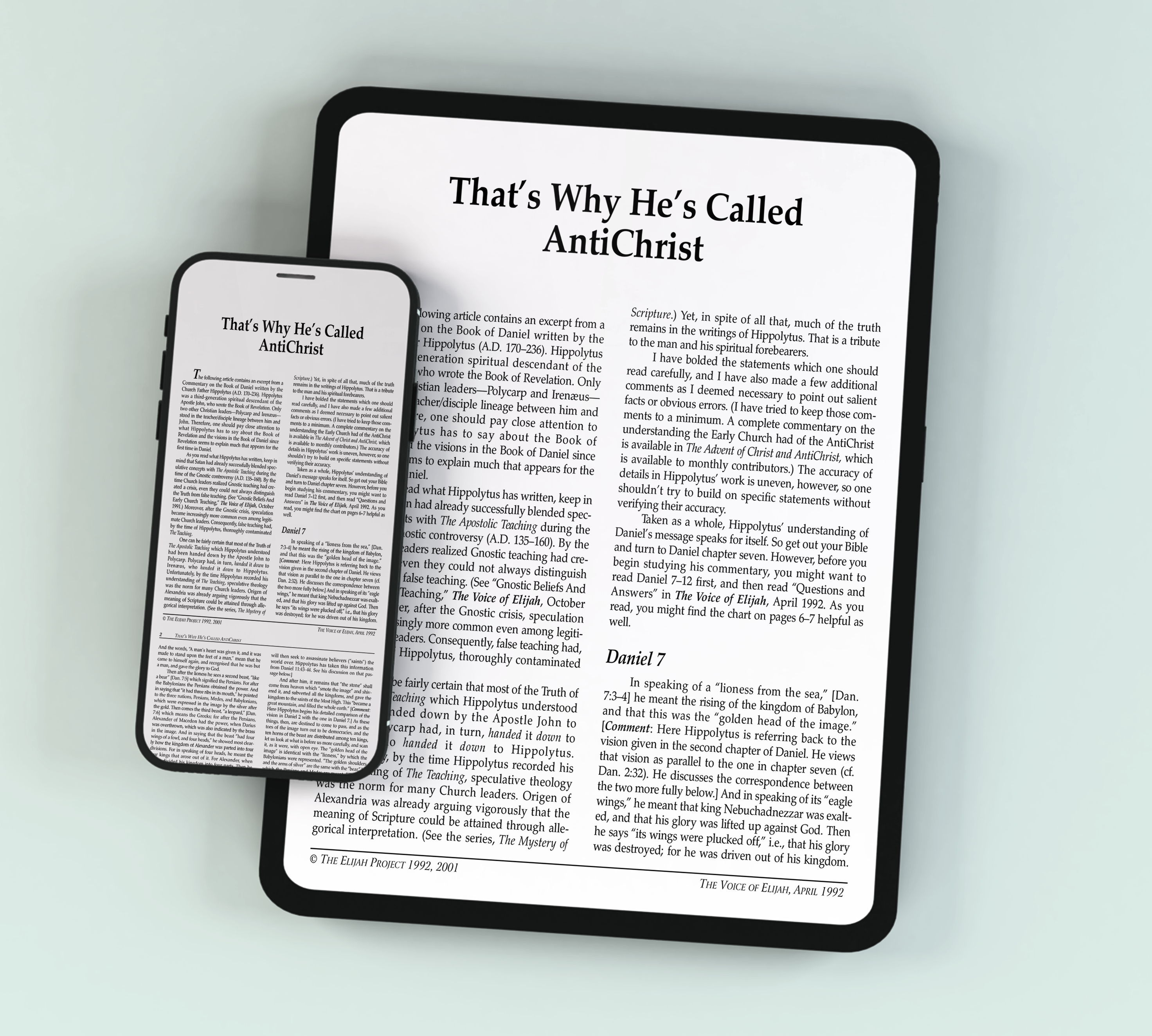
Free ebook: That’s Why He’s Called AntiChrist!
View the full ebook based off this article. Learn more about End Times truths. The ebook (PDF) provides more detailed explanations, additional scriptural references, and further insights into The Apostolic Teaching. We encourage you to download it for a more comprehensive understanding of these vital concepts.
Read ebook Now!U.S. Only Offer: Get a Hard Copy of the HSSB Bible. Limited Supply!
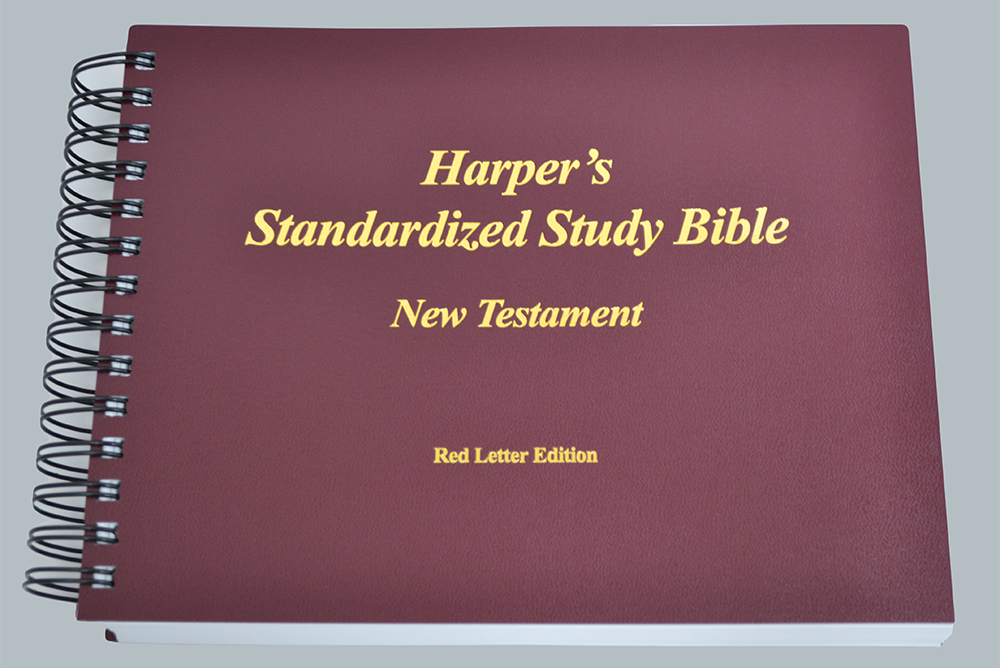
Harper’s Standardized Study Bible, New Testament, Red Letter Edition
An original translation of the Greek New Testament into English with Jesus Christ’s words printed in red. The red text enables readers to easily locate the Lord’s spoken words at a glance. A true study Bible that is spiral bound and lays flat for ease of note taking. Each page dedicates one column for personal notes.
Learn More