


The Liberal Challenge to Faith (Belief)
Liberal theologians claimed:
- The Bible contained errors, particularly regarding miracles, concluding that faith could not be based on reason.
- Their argument followed a circular path: reason does not allow for miracles, therefore biblical miracles must be errors.
These scholars particularly questioned the veracity of Scripture’s Creation Account. After extensive scholarly debate, they determined that faith and reason were irreconcilable. This led philosophers to establish a basis for faith that required suspending reason and making a “leap of faith,” believing things considered irrational.
The liberals confused the terms normal and rational, making them synonyms. For them, normal expectations of natural phenomena became the only rational expectation, making supernatural phenomena (miracles) inherently irrational.
The Conservative Response
In response to liberal positions, conservative seminaries developed courses in Apologetics (from the Greek word apologia, meaning “defense”). Through rational Christian belief through Apologetics, conservatives sought to defend faith’s rational basis. They offered various proofs for God’s existence, including cosmological arguments based on universe characteristics and ontological arguments analyzing the nature of being.
Neither side would be convinced by the other’s arguments, leading each to tailor messages for their own audience. The liberal view remains dominant in:
- most public institutions of higher education and
- theological seminaries, where professors still teach theories about Scripture developed by evolution proponents from the previous century.
Understanding the Relationship Between Evidence and Belief (Faith)
Evidence vs. Proof: Understanding the Distinction
Understanding evidence-based belief requires recognizing two fundamental challenges. First, while evidence is objective, proof is subjective—existing only in the mind of the individual.
As with the courtroom analogy:
- Lawyers don’t win cases solely through objective evidence and rational arguments; they must convince subjective jurors.
- The best lawyers know that people unmoved by convincing arguments might be influenced emotionally.
- Two juries hearing identical evidence might reach different verdicts, demonstrating proof’s subjective nature.
The Challenge of Proving Non-Existence
The second challenge involves the impossibility of proving non-existence:
- While existence can be proven through sensory evidence, non-existence cannot be definitively demonstrated.
- Absence of presence is not the same as non-existence.
How Conservatives Preserved the Meaning of Faith
The core essentials of Christian faith became a crucial focus when conservatives recognized the dangers of the liberal position. Between 1910 and 1915, conservative Protestants published The Fundamentals: A Testimony of the Truth, establishing what they considered salvation’s essential beliefs. This response protected the Protestant Reformation’s gains regarding salvation through faith. Without this challenge, the Gospel message would have been diluted to meaningless words. By the end of the previous century, the liberals’ devaluation of faith was complete—if faith were irrational to begin with, the content of one’s belief became irrelevant.
What the Bible Says on the Relationship Between Faith and Evidence
Faith and belief in Scripture reveals that:
- the English word faith derives from Latin fides (meaning “trust”),
- the Greek word pistis means “trust,” “confidence,” and “belief.”
- The verbal root peitho means “to persuade” or “to offer proof.”
This etymology demonstrates that biblical faith results from being persuaded by evidence—contradicting liberal theology’s assertion that faith is irrational. If you haven’t been convinced by the evidence you’ve seen, heard, or otherwise apprehended, you do not really believe.
The Scriptures emphasize that:
without belief in God’s promise [editor: faith] {it is} impossible to be well-pleasing.
(Hebrews 11:6b) —Harper’s Standardized Study Bible
Paul teaches that:
“belief in God’s promise [editor: faith] {is} on the basis of hearing, but your hearing {is} via a statement made concerning the Anointed One.”
(Romans 10:17b) —Harper’s Standardized Study Bible
This establishes a logical sequence: evidence of the Gospel leads to persuasion through hearing, resulting in belief. The strength of one’s faith correlates with the convincing nature of the arguments presented.
Grow in Faith Through Your Understanding of the Gospel Message
Christians can be “weak in faith” (Rom. 14:1–8), showing this weakness through actions that limit their freedom in Christ and desire to restrict others.
Some regard certain days above others or restrict their diet unnecessarily. However, faith grows through deeper understanding of the Gospel:
(i) For we are not overextending ourselves {by boasting} like those who are not reaching out to you.
(ii) For we have attained {results} even as far as you through the good news of the fulfillment of the promise of the Anointed One:
(a) not boasting about the things that cannot be measured—about other troubles {we have}—but
(b) having a hope that, while your belief in God’s promise [editor: faith] is made to grow within you, {it} would be exalted into an abundance in accordance with the standard {of the truth} we have:
(i) so as to proclaim the good news of the fulfillment of the promise to the places beyond you,
(ii) so as not to boast about my readiness {to proclaim the good news of the fulfillment of the promise} by {the} standard of another.
(2 Corinthians 10:14–16) —Harper’s Standardized Study Bible
Jesus emphasized this growth process:
Therefore, Jesus was saying to the Jews who believed Him, “If you continue on in the word that I have, you truly are My disciples; and you will know the truth, and the truth will set you free.”
(John 8:31–32) —Harper’s Standardized Study Bible
Paul and Peter both encouraged Believers to “stand firm in the faith” (1 Cor. 16:13; 2 Cor. 1:24; 1 Pet. 5:8–9), recognizing the possibility of straying from Truth. James acknowledges this as a common occurrence, noting that turning:
a sinner back from {the} deception of his way will save his soul from death.
(James 5:20b) —Harper’s Standardized Study Bible
Paul specifically mentions Hymenaeus and Philetus, who:
deviated from the truth, saying that the resurrection has already occurred.
(2 Timothy 2:18b) —Harper’s Standardized Study Bible
Salvation comes through believing the Gospel message about Jesus Christ. Scripture confirms we are:
- “sanctified by faith” [editor: “belief in God’s promise” ] (Acts 26:18),
- “justified by faith” [editor: “belief”] (Rom. 3:28; 5:1; Gal. 2:16; 3:8, 24), and
- faith is our “righteousness” [editor: “declaration of not guilty”] (Rom. 4:5; 9:30; 10:6; Phil. 3:9).
As Paul states:
For because of His favor you are those who have been saved via belief in God’s promise [editor: faith], and this offering of God {is} not because of you—not because of works—so that no one could boast.
(Ephesians 2:8–9) —Harper’s Standardized Study Bible
How to Hold on to Your “Faith” (Belief) in the End Times
Faith in the Last Days takes on particular significance. Paul warns that many will “turn their ear away from the truth” and
will not put up with our sound teaching; but those who have the ear that itches will pile up teachers for themselves, in agreement with their own selfish desires
(2 Timothy 4:3b) —Harper’s Standardized Study Bible
The survival of faith depends not on guesswork or tradition but on embracing doctrinal Truth and knowing God’s complete plan as described in the Gospel. James pointedly observes:
You believe that the {living} God is One. You are doing exceptionally well; the demons also believe {the same thing}, and they shiver.
(James 2:19) —Harper’s Standardized Study Bible
Would you know the Truth if you heard it? Or would you be content with traditional teachings? Jesus assured that those willing to do God’s will would recognize His Teaching (John 7:16b–17). He also challenged those who searched Scriptures believing they contained eternal life, yet they failed to come to Him for that life (John 5:37–40).
A faith based on incomplete understanding will not endure the coming delusion. For centuries, basic knowledge of Christ’s death and Resurrection sufficed for saving faith, but that day is ending. Only those who believe the Truth of the Gospel will persist to the End. The critical question regarding pistis (faith/belief) becomes “persuaded by what evidence?” In these Last Days, examining what one believes becomes not just important but essential for survival.
Conclusion
Faith, as revealed in Scripture, is not an irrational leap into darkness but a reasoned response to divine evidence presented through the Gospel message. The liberal devaluation of faith’s content has led many Believers into dangerous territory, accepting a watered-down version of belief that cannot withstand serious scrutiny. In these Last Days, where deception abounds, only those who ground their faith in the complete Truth of the Gospel—not just selected portions or traditional interpretations—will find themselves equipped to endure to the End.
This blog post presents a condensed overview of the critical relationship between faith and evidence. For a more comprehensive exploration of this topic, including scriptural analysis and historical context, we encourage you to download the complete ebook, which delves deep into the theological implications and practical applications of biblical faith.
On our website you have access to a wealth of free resources on the Online Library designed to help you understand and strengthen your belief in God’s promise (faith) through an understanding of the Bible. The Truth is available. It’s your choice.
FREE Downloadable Content
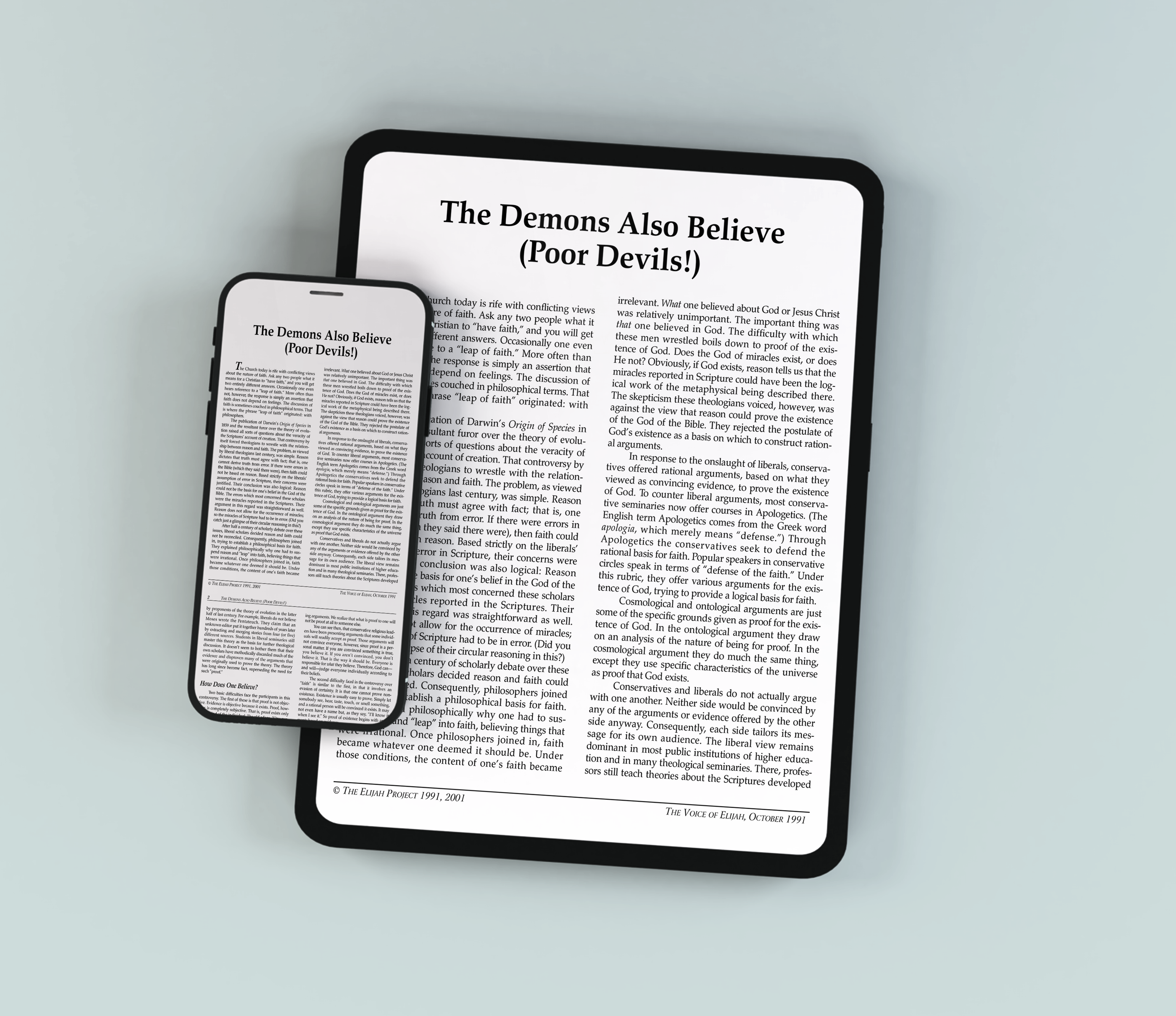
Free ebook: The Demons Also Believe (Poor Devils!)
View the full ebook based off this article. Learn more about End Times truths. The ebook (PDF) provides more detailed explanations, additional scriptural references, and further insights into The Apostolic Teaching. We encourage you to download it for a more comprehensive understanding of these vital concepts.
Read ebook Now!U.S. Only Offer: Get a Hard Copy of the HSSB Bible. Limited Supply!
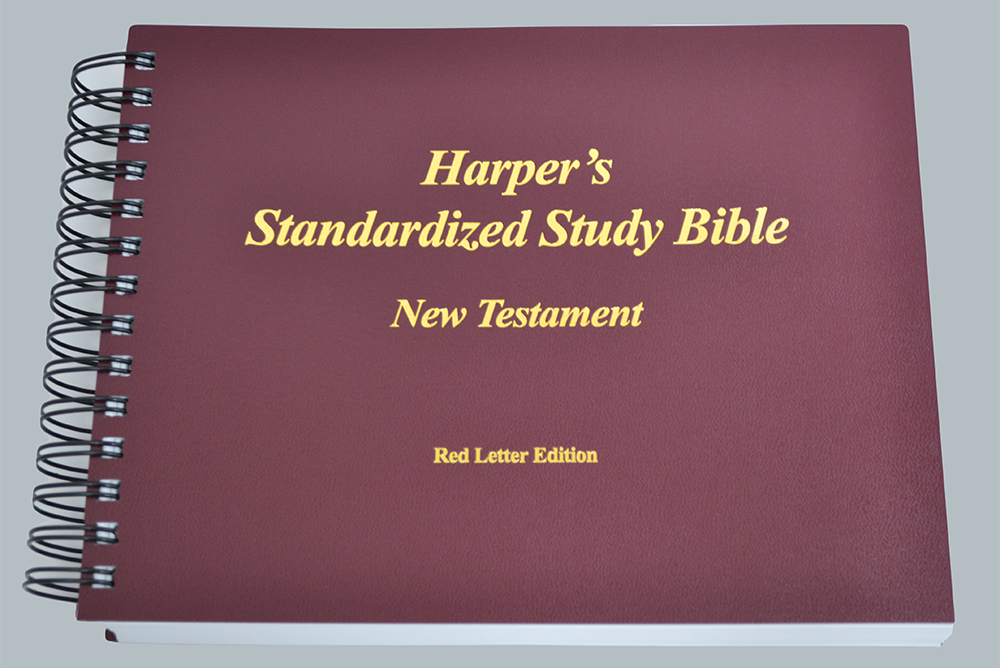
Harper’s Standardized Study Bible, New Testament, Red Letter Edition
An original translation of the Greek New Testament into English with Jesus Christ’s words printed in red. The red text enables readers to easily locate the Lord’s spoken words at a glance. A true study Bible that is spiral bound and lays flat for ease of note taking. Each page dedicates one column for personal notes.
Learn More