


The Early Church Fathers’ View of Biblical Interpretation
Most people tend to remain within their initial religious tradition, whether:
- Christian,
- Jewish,
- Muslim,
or a specific denomination within these faiths. That predisposition holds true for various divisions within a religion as well.
“It’s important to recognize that every religious tradition changes over time.”
Therefore, the Catholic often remains Catholic, the Sunni Muslim remains Sunni Muslim, the Reformed Jew remains Reformed, etc. So traditionally, Christian beliefs have been shaped by the religious environment in which an individual has been raised.
However, it’s important to recognize that every religious tradition changes over time. There are at least two sources for the transformation of religious beliefs. Change can come from external sources, such as:
- new converts bringing in elements of their former beliefs, or
- from some internal impetus by which adherents seek to change their own tradition.
There is, first of all, an external threat posed by new converts. Former religious beliefs and old social customs can sometimes prove hard to relinquish; therefore, converts quite often hold tightly to them when coming into the Church.
The second source of change can originate within a particular Christian tradition. Adherents of a religion are sometimes influenced by:
- The beliefs of another religion and
- appropriate alien concepts
which they integrate into their own religion in much the same way as new converts. This holds true in connection with the origin of the Church’s varied beliefs concerning methods of biblical interpretation. For the most part, the Early Church Fathers borrowed their methodology from both Greek philosophy and the Jews.
When Did People Start Insisting the Bible Should Be Read Literally?
The Protestant Church was established by Reformers like Martin Luther and John Calvin, men who sought to restore what they believed the Catholic Church had lost. This Reformist mind-set continued to spawn new movements within Protestantism, often aiming to recover more of the Truth than what was regained during the Reformation.
The Pentecostal and Neo-Pentecostal movements were part of the last major attempt by the Holiness Movement to restore The Apostolic Teaching that the leaders of the Early Church lost.
But from the time of
- Johann Arndt (1555–1621),
- and especially since John Wesley (1703–1791),
holiness-minded folk have argued that True Believers should not only adhere to the Truth recovered during the Reformation but should also return to an even earlier Christian tradition.
The Truth is, these additional Reformational attempts, including the Holiness Movement and Pentecostalism, have fallen far short of fully restoring the original tradition of the Early Church. The Pentecostal and Neo-Pentecostal movements were part of the last major attempt by the Holiness Movement to restore The Apostolic Teaching that the leaders of the Early Church lost. It should be obvious to all (but isn’t) that all factions of the Holiness Movement of the past two centuries, including the Pentecostals, have now settled into a contented reliance on their traditional beliefs and Christian Church norms.
How Did the Early Church Fathers Interpret Scripture?
The short answer is, they didn’t. When examining the history of biblical interpretation, it’s crucial to look at the earliest written records of the Early Church and compare them with the teachings found in the Scriptures. Three Church Fathers—Justin Martyr, Irenæus, and Tertullian—are recognized as having stood firmly on the side of Christian Orthodoxy during the second century. These men believed the duty of the Teachers in the Church was:
- Not to “interpret” the Scriptures,
- To accurately “understand” and teach The Apostolic Teaching that had been handed down to them.
Unfortunately, Patristic hermeneutics also emerged during this period, shaping how subsequent generations approached biblical texts.
“The Early Church Fathers held that the Apostolic tradition was crucial for a true understanding of the scriptural message.”
For nearly two centuries, the Early Church Fathers did not believe their task was to interpret the Scriptures. Instead, they were committed to teaching their understanding of the Old Testament—The Apostolic Teaching—which they insisted Jesus Christ had revealed to His Apostles.
Moreover, their testimony is unmistakably clear regarding their understanding that the Old Testament Gospel message concerning Jesus Christ had been hidden in parables.
What Is the Role of Apostolic Succession in Interpreting Scripture?
The Early Church Fathers held that the Apostolic tradition was crucial for a true understanding of the scriptural message. They insisted:
- The only way to acquire an accurate understanding of The Apostolic Teaching was to be taught by a Teacher who stood in the Apostolic succession—that is, by someone who had been taught the Church’s accurate understanding of the Scriptures by someone legitimately ordained to be a Teacher.
- That the unity of belief exhibited by the Apostolic Churches was proof of their Apostolic descent.
Irenæus, for instance, believed that the Old Testament was full of types and parables, with the Truth regarding the birth, life, death, and Resurrection of Christ hidden in the Scriptures and made known through these types and parables.
“Early Christian leaders did not think that the message of Scripture could be easily understood by anyone.”
He argued that only the churches in the Apostolic succession possessed the key to unlocking all the mysteries regarding the First and Second Coming of Christ.
Similarly, Justin Martyr understood many passages of Scripture typologically, showing that Jesus was the Messiah through this lens.
Even outside the Apostolic tradition being handed down by legitimate Church Teachers, allegorical and typological methods were often how early theologians outside the Church interpreted the Bible.
Tertullian, who was writing some one hundred and seventy years after the death and Resurrection of Jesus Christ, had no interest in interpreting the Scriptures for himself. His arguments against the Gnostics clearly demonstrate he gained his understanding of the Truth of the Old Testament Gospel of Jesus Christ from Teachers who taught in churches established by the Apostles themselves.
Did the Early Church Fathers Reject Literal Interpretation?
Contrary to modern beliefs, Early Christian leaders did not think that the message of Scripture could be easily understood by anyone who wanted to read and interpret it independently. Instead, they believed:
- The message of the Old Testament had been intentionally concealed in parables and enigmatic statements.
- That Jesus had revealed the meaning of the Scriptures to the Apostles alone.
- This understanding was known only in the churches founded and taught by the Apostles.
Patristic critiques of literalism were rooted in this understanding.
Early Christian leaders did not believe that God intended the prophecies of the Old Testament to be understood “literally” in the way that many claim today. They believed the Prophets made parabolic statements which were to be understood allegorically.
This aligns with the Apostle Paul’s statement about his understanding that the story of Sarah and Hagar had an allegorical meaning:
(a) For it has been written that Abraham had two sons—
(i) one from the slave girl and
(ii) one from the free woman. But:(a) one was engendered from the slave girl, in accordance with flesh;
(b) the other from the free woman, via a promise, which is what is being implied figuratively; for these individuals are two testaments:(i) one is, in fact, from Mount Sinai, which is Hagar, who is engendering children into slavery. Now, Hagar is Sinai, a mountain in Arabia; but she lines up with the present Jerusalem, for she is a slave along with her children.
(ii) But the Jerusalem above—who is our mother—is a free woman.(Galatians 4:22–26) —Harper’s Standardized Study Bible
Paul’s use of the Greek term allegoroumena (translated as “allegorically speaking”) refers to a type of allegorical interpretation well-known in his day. However, it’s important to note that:
- Paul didn’t imply he used any allegorical methodology to interpret the Scriptures himself.
- He plainly states that he gained his understanding of the Old Testament message through revelation from Jesus Christ (Gal. 1:9–12).
The Early Church Fathers understood that alongside passages with literal meaning, there were passages containing an allegorical meaning intentionally hidden in parabolic images—which are also often called “types.” This same assertion is still made today, even by those who insist on literal interpretation. Moreover, many Old Testament passages with literal meaning describe historical events that were orchestrated by God as parabolic pantomime. The writer of the Book of Hebrews, for example, understood them that way.
The evidence for the Early Church belief in the parabolic meaning of Scripture is overwhelming and stated repeatedly throughout the earliest Christian writings. This same view is expressed even within the New Testament. Everyone knows Jesus spoke in parables, but not many know the Prophets did the same thing.
What Are the Problems With Literal Interpretation of the Bible?
The historical evidence mentioned above offers little encouragement to those today who insist on a strictly literal interpretation of the Scriptures. It should, in fact, discourage anyone seeking the Truth from offering their own off-the-cuff opinion as to the meaning of Scripture. The problems with literal interpretation of the Bible become readily apparent when one considers the Early Church’s approach.
The current prevalent belief in literal interpretation of the Hebrew Scriptures should be seen as evidence that the Church has “turned away from” God’s tradition, just as the sons of Israel had done so many times before.
The Truth is, God has always intended His People to adhere to His way—His tradition—the one that He established through The Teaching of Moses at the time of the Exodus from Egypt. This tradition was repeatedly restored by the Prophets throughout Israel’s history and was reestablished when Jesus Christ revealed The Teaching to His Apostles.
The Church “turned away from” God’s tradition just as the sons of Israel had done before, and the current belief in literal interpretation is a testament to this fact. God does not always have positive feelings toward tradition, especially when it is merely the tradition of men rather than God’s Truth.
From Reformation to Superficial Change: The Decline of True Revival in Modern Churches
The Protestant Reform movement has faltered over the last fifty years, with many now talking about
- “Church renewal” and
- Megachurches
as though superficial changes and larger gatherings of “believers” who have never been born again are the answer.
“The current emphasis on literal interpretation is a relatively recent development that fails to capture the rich, multi-layered meaning of Scripture as understood by Early Church leaders.”
In contrast to the thousands of new converts who joined reform movements in past centuries, recent attempts to reestablish the New Testament Church have resulted in the establishment of nothing more than a variety of independent churches.
Even the most ardent Reformers have grown weary of their quest for the Truth understood by the Early Church Believers because they have no idea as to how to look for it. Many have returned to established Church norms or fallen prey to charlatans who are offering the widespread “feel-good” religion which has no interest in understanding the Truth hidden in the Scriptures.
The biblical viewpoint is:
- God’s tradition is acceptable;
- man’s tradition isn’t.
Isaiah condemns the sons of Israel for their rejection of God’s tradition and blind adherence to their human traditions:
Then the Lord said,
“Because this people draw near with their words
And honor Me with their lip service,
But they remove their hearts far from Me,
And their reverence for Me consists of tradition learned by rote.”(Isaiah 29:13) —NASB
Jesus condemns the Pharisees for doing the same thing at the expense of rejecting God’s commandments:
“This people honors Me with their lips,
But their heart is far, far away from Me.
So they are worshiping Me futilely,
Teaching teachings—religious precepts—of men.”(Matthew 15:8–9) —Harper’s Standardized Study Bible
Early Church Wisdom Challenges Modern Literal Scripture Interpretation
The evidence from history and the Scriptures themselves presents a strong case against the modern insistence on a literal interpretation of Scripture, proving that this approach is not in line with the understanding and practices of the Early Church and the Apostles. It demonstrates that the current emphasis on literal interpretation is a relatively recent development that fails to capture the rich, multi-layered meaning of Scripture as understood by Early Church leaders
A restoration of the beliefs of the Early Church—one that is:
- based on both literal and allegorical meanings in the Scriptures
- and prioritizes The Apostolic Teaching that was passed down from the Apostles—
must be faithful to the beliefs of the Early Church Fathers.
This perspective challenges many contemporary approaches to biblical interpretation and calls for a reevaluation of how modern Christians understand and apply Scripture.
Why Is the History of Biblical Interpretation Important?
The publication of Thomas Aquinas’ Summa Theologica in the thirteenth century provided the basis for:
- Modern theories of interpretation, including
- The literal interpretation theory.
However, it must be emphasized that this publication appeared nearly six hundred years before the literal interpretation theory gained widespread acceptance. For that reason an understanding of the Truth regarding the historical development of biblical interpretation since the time of Thomas Aquinas is of the utmost importance.
The point is, the Truth regarding any assertion of Patristic biblical interpretation should inform every modern approach to an accurate understanding of the Scriptures. No one in Protestant Christianity today bothers to base their interpretive methodology on the writings of anyone prior to the Protestant Reformation.
If one is serious about claiming an “orthodox” method of biblical interpretation, one should base that claim on:
- The lack of any special method of interpretation in the Early Church—not on one from the thirteenth century or even the late fourth century.
- The lack of any method of interpretation, which is what held sway from the time of the Apostles until the late second century.
There is a dire danger in relying on recent theological writings. Lutheran theologians often appeal to the writings of Martin Luther; Reformed theologians, to John Calvin; and Methodists, to John Wesley.
To accurately understand the message of the Scriptures:
- One must look beyond recent traditions and
- Return to the Early Church roots of Christian biblical interpretation and
- Consider the understanding of the Scriptures that was held by those closest to the time of Christ and the Apostles.
This perspective is a profound critique of contemporary approaches to Bible study and interpretation, suggesting that much of what is considered “orthodox” today may, in fact, be a serious departure from the original Christian understanding of the Scriptures.
FREE Downloadable Content

Free ebook: Did You Mean That Literally?
View the full ebook based off this article. Learn more about End Times truths. The ebook (PDF) provides more detailed explanations, additional scriptural references, and further insights into The Apostolic Teaching. We encourage you to download it for a more comprehensive understanding of these vital concepts.
Read ebook Now!U.S. Only Offer: Get a Hard Copy of the HSSB Bible. Limited Supply!
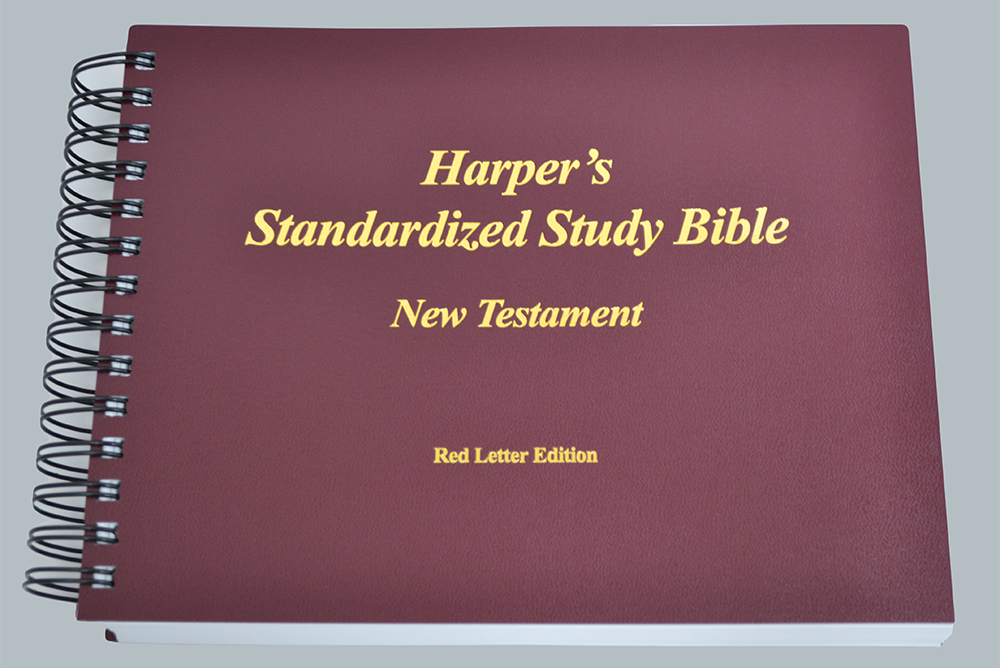
Harper’s Standardized Study Bible, New Testament, Red Letter Edition
An original translation of the Greek New Testament into English with Jesus Christ’s words printed in red. The red text enables readers to easily locate the Lord’s spoken words at a glance. A true study Bible that is spiral bound and lays flat for ease of note taking. Each page dedicates one column for personal notes.
Learn More