


The Parable of the Sower: How Parables Reveal and Conceal the Truth
Understanding the parables of Jesus requires recognizing that:
- They do not stand alone as individual units.
- Each one is part of an ongoing discourse where Jesus explained particular facets of The Teaching to His disciples.
While I can now freely explain the meaning of Jesus’ parables, I cannot yet explain their significance openly. The fool will accept my explanation and think he understands all he needs to know. Don’t tell him he doesn’t. Let him find out the hard way.
To understand the parables, you must first understand that every parable contains at least one parabolic image whose meaning and significance is concealed in and revealed by its corresponding Hebrew idiom. In the Parable of the Sower, the central parabolic image is the Seed the Sower sows, but an understanding of the meaning and significance of the parable requires insight into the Hebrew idiom “raise up a seed.”
Before examining the Parable of the Sower, consider its context. Matthew tells us Jesus had just conducted a parabolic pantomime in which He made an oral testament that was valid under both Roman and Jewish law. As Matthew records:
Guess what! While He was still speaking to the crowds, His mother and brothers were standing around outside, seeking to speak to Him. So someone told Him: “Guess what! Your mother and Your brothers are standing around outside seeking to speak to You.”
But in response, He said to the one who was telling Him, “Who is My mother, and who are My brothers?”
And after stretching out His hand over His disciples, He said: “Guess what! These are My mother and My brothers! For whoever it might be who acts in accordance with the will of My Father, Who is in {the} heavens, he is My brother and sister and mother.”
(Matthew 12:46–50) —Harper’s Standardized Study Bible
Symbolism of the “Seed”: How Seed Represents God’s Teaching
Biblical seed symbolism is central to an understanding of this parabolic pantomime [editor note: Parable of the Sower], since the parabolic image of the Seed represents the Truth of The Teaching throughout Scripture. Depending on context, it could represent:
- The Teaching of Moses,
- The Teaching of the Prophets,
- The Teaching of Jesus, or
- The Apostolic Teaching.
While these Teachings differ in historical perspective, they share essentially the same content. The Teaching of Moses is the most cryptically stated, while The Apostolic Teaching is most detailed and openly explained.
The Parable of the Sower’s meaning depicts how mortal man—a seed—can be transformed into an immortal creature—a plant—through belief in The Teaching—a Seed—which replicates itself in the Believer. The parabolic imagery points to two entirely different “seeds” and “plants,” and an understanding of that depends on knowing we are what we believe; therefore, both of those “seeds” and “plants” can sometimes be one and the same.
Consider what happened after Christ’s Resurrection. As Luke records:
Then He opened up their mind to comprehend the Scriptures.
(Luke 24:45) —Harper’s Standardized Study Bible
The scriptural context of the Parable of the Sower allows us to see how Christ supernaturally enabled His disciples to understand the Truth of The Teaching. As Jesus explained in the Parable of the Sower, when that Seed of Truth enters the heart—the mind—of one who is able to hear, it “sprouts” and that person becomes a new “plant.”
The Apostle Paul understood this principle perfectly, stating:
(i) I planted {the Seed};
(ii) Apollos gave {It} a drink, but
(iii) the {living} God was {the Seed} growing {in you}. So then neither is the one who plants {the Seed} anything nor the one who gives {It} a drink, but the {living} God Who is {the Seed} growing {in you} {is everything}.(1 Corinthians 3:6–7) —Harper’s Standardized Study Bible
God’s plan worked fine until Origen and his ilk came along “planting” their nonsense among God’s “Seed.” That’s when God resorted to His contingency plan, which is described in the Parable of the Tares.
What is the Meaning of Harvest Imagery in Scripture?
In the Parable of the Tares, Jesus warns how Satan would contaminate The Teaching by sowing false teaching as a “seed” that would “sprout” and “grow” in the Pretenders who believed it. Jesus explains that at the End of the Age, God will “winnow out” these Pretenders from those who actually understand and believe the Truth. As John the Baptist declared to the Pharisees and Sadducees:
“Whose winnowing fork {is} in His hand; and He will cause His threshing floor to be cleaned thoroughly, and He will gather His wheat into the storehouse, but He will burn up the chaff in an unquenchable fire.”
(Matthew 3:12) —Harper’s Standardized Study Bible
The Prophet Jeremiah described this same Truth this way:
“A scorching wind from the bare heights in the wilderness in the direction of the daughter of My people—not to winnow, and not to cleanse, a wind too strong for this—will come at My command.”
(Jeremiah 4:11b–12a) —NASB
The harvest imagery in this Scripture describes how, after that hot, dry desert wind has served His purpose in winnowing the chaff from God’s “Seed,” He will turn on all those fools who failed to pay attention when attention was due.
You Can Only Understand the Truth (The Teaching) By ...
You cannot understand these parables until you accept that we are what we believe. God has never planted any “Seed” in the Earth other than when Jesus Christ was buried in the tomb. That is also the only “Seed” He will harvest and store in His barns. As John stated, “In the beginning, there was the Word; and the Word was with the {living} God, and the word was God.” The Teaching is like Light, enabling those who believe it to see what is happening around them.
Jesus emphasized this Truth repeatedly. When His disciples failed to cast out a demon, He rebuked their lack of faith, saying:
So He tells them: “Because of your little belief. For without doubt I tell you, if you have belief in God’s promise [editor note: faith] as much as a grain of mustard, you will tell this mountain, ‘Move on from here to there,’ and it will move on; and nothing will be impossible for you.”
(Matthew 17:20) —Harper’s Standardized Study Bible
Jesus was talking about their belief in the Truth of The Teaching, the same thing He referred to in the Parable of the Sower.
The Truth embodied in The Teaching holds incredible value for those with ears to hear and understand it. As Jesus explained through multiple parables: “The kingdom of the heavens is just like a treasure that has been hidden in the field” and “the kingdom of the heavens is just like a man—a merchant—who is looking for exceptionally good pearls” (Matt. 13:44–45).
Jesus Christ is the Kingdom of Heaven, the mustard seed, the bread—yet all these parabolic images point to the fact that Jesus Christ is The Teaching He firmly believed.
Mark records Jesus warning His disciples:
And He was telling them: “Watch what you listen to. In whatever measure you measure {something} out, it will be measured out for you; and it will be added to you. For whoever has, it will be given to him; and whoever does not have, even what he has will be taken away from him.”
(Mark 4:24–25) —Harper’s Standardized Study Bible
His point is clear: The Teaching is like a Light which, though long hidden in the Scriptures, will eventually be seen by everyone—by most after it’s too late to do them any good.
Remember what Jesus said about the consequences of what we believe and teach:
“The good man takes good things out of his good treasure, and the nasty man takes nasty things out of his nasty treasure. But I tell you that, on {the} day of sentencing, men will pay for every idle statement that they make about His word.”
(Matthew 12:35–36) —Harper’s Standardized Study Bible
If you comprehend even a little bit of The Teaching, that little bit will enable you to understand even more. However, if you don’t understand any of it at all, you will eventually lose what you mistakenly think you have.
The parables of Jesus all point to one central Truth: He is the Word of God—The Teaching that one must believe to inherit the promise. The most fascinating aspect isn’t just what He says, but how the connection between Old and New Testament parables perfectly fit into the intricate portrait that Moses and the Prophets painted of Him as “The House” of Israel Who became “The House” of God. As further evidence of this Truth, consider what Jesus told His disciples about why He spoke in parables:
So, in response, He told them that “it has been given to you to know the mysteries of the kingdom of the heavens, but it has not been given to those individuals. For to him who has, it will be given, and he will have an excess; but from him who does not have, even what he has will be taken away.”
(Matthew 13:11–12) —Harper’s Standardized Study Bible
Jesus then quoted the Prophet Isaiah to explain why God insisted that He and all the other Prophets speak in parables:
“You will hear {the mysteries} with {your} ear,
And you will definitely not comprehend {the mysteries};
And you who are looking at {the mysteries} will look at {the mysteries},
And you will definitely not see {the mysteries}.”(Matthew 13:14b–15) —Harper’s Standardized Study Bible
Only Those Who Understand The Teaching Will Inherit the Promise
Most people have no interest in understanding the Truth. Yet belief in the Truth is the only requirement God has ever placed on individual inheritance of the promise. Consider the parable where Jesus explained how The Teaching works:
And He was saying: “The kingdom of the {living} God is like this: as if a man had cast his seed-grain onto the ground, and he sleeps and gets up—during {the} night and {each} day—and the seed-grain sprouts and grows longer. He does not know how.”
(Mark 4:26–27) —Harper’s Standardized Study Bible
After telling this parable in which He—the Kingdom of God—was like a sower, Jesus went on to tell the Parable of the Tares where He plainly identified Himself as the Sower He had in mind. The Lord spoke to Jeremiah about this same Truth:
“Thus says the Lord God of Israel, ‘Like these good figs, so I will regard as good the captives of Judah, whom I have sent out of this place {into} the land of the Chaldeans. ‘For I will set My eyes on them for good, and I will bring them again to this land; and I will build them up and not overthrow them, and I will plant them and not pluck {them} up.”
(Jeremiah 24:5–6) —NASB
The casual reader has no idea what the Prophet is talking about, but his meaning should be clear to anyone who knows what Moses wrote. Jesus made the connection clear when He said:
Then He told them, “For this reason every scribe who has become a disciple in the kingdom of the heavens is just like a man—an owner of a house—who takes new and old {things} out of his treasure.”
(Matthew 13:52) —Harper’s Standardized Study Bible
Jesus meant that every scribe who became His disciple is like a man responsible for teaching his children, bringing forth things they have heard and haven’t heard based on his knowledge of The Teaching.
When Jesus told the Parable of the Leaven—“The kingdom of heaven is like leaven, which a woman took, and hid in three pecks of meal, until it was all leavened” (Matt. 13:33 —NASB)—the word translated “meal” actually means “wheat flour.” Matthew tells us Jesus told this parable at the same time as the Parable of the Sower, showing us that the emphasis isn’t on the flour but on the “Seed” from which it came.
Jesus also said of Himself:
“I am the bread of life. Your fathers ate the manna and died in the desert. This Individual is the bread that is going to come down out of Heaven so that anyone may eat some of Him and not die.”
(John 6:48–50) —Harper’s Standardized Study Bible
He then conducted two parabolic pantomimes feeding thousands with just a few loaves of bread, to show that The Teaching is just like the seed used to make those loaves of unleavened bread. All they had to do was distribute The Teaching and, like the bread, it would remain just as much as it was before.
The Parable of the Mustard Seed reveals another aspect of this Truth:
“The kingdom of Heaven is just like a grain of mustard that a man, after accepting {it}, sowed in his field; the {grain} that, on the one hand, is smaller than all the seeds; but on the other hand, when it has been made to grow, is larger than the cultivated plants and becomes a tree.”
(Matthew 13:31b–32a) —Harper’s Standardized Study Bible
In that parable, Jesus is alluding to what Ezekiel said about Him as the One Who would be, in Himself, “The House” of Israel, the One Who is and always will be the Kingdom of God.
If you intend to be one “who endures to the end,” you must carefully examine everything you believe. The Truth of The Teaching that Jesus taught His Apostles after His Resurrection is your only hope of endurance. Otherwise, you are destined to be nothing more than “chaff” that God is going to separate from His “Seed” through a hot, dry desert “wind” and consign to burn forever in the fires of Hell. I can say this with complete confidence because I know that we all act in accordance with what we believe.
Conclusion
The meaning and significance of the Parable of the Sower serves as a masterful revelation of how The Teaching—which is embodied in Christ Himself—takes root in those who are able to hear and understand. Through an intricate biblical “seed” symbolism and Hebrew idioms like “raise up a seed,” Jesus wove together the prophetic threads that Moses and the Prophets had carefully crafted, revealing Himself as both “The House” of Israel and the Living Word of God. Understanding Jesus’ parables requires recognizing that we are what we believe, and only by believing the Truth of The Teaching can we hope to be transformed from a mortal “seed” into immortal “plant.”
This article offers just a glimpse into the content contained in the full ebook, where you’ll discover even more parabolic imagery, Hebrew idioms, and mysteries that Jesus revealed through His parables. The complete work provides scriptural evidence and careful exposition that will deepen your understanding of how God has preserved The Teaching throughout time.
Visit our Online Library to access more free resources that will help you grow in your knowledge of The Teaching.
FREE Downloadable Content
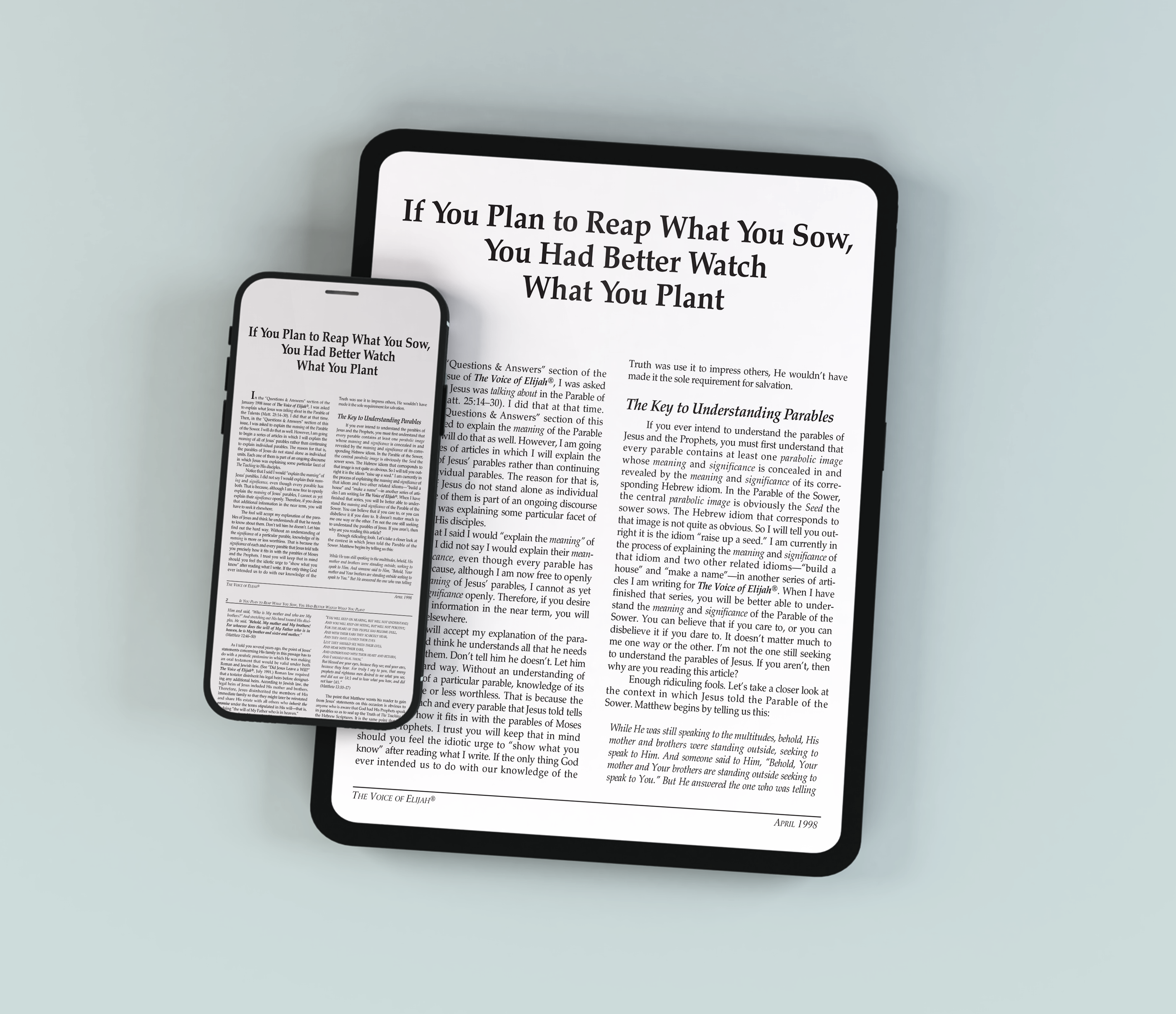
Free ebook: If You Plan to Reap What You Sow, You Had Better Watch What You Plant
View the full ebook based off this article. Learn more about End Times truths. The ebook (PDF) provides more detailed explanations, additional scriptural references, and further insights into The Apostolic Teaching. We encourage you to download it for a more comprehensive understanding of these vital concepts.
Read ebook Now!U.S. Only Offer: Get a Hard Copy of the HSSB Bible. Limited Supply!
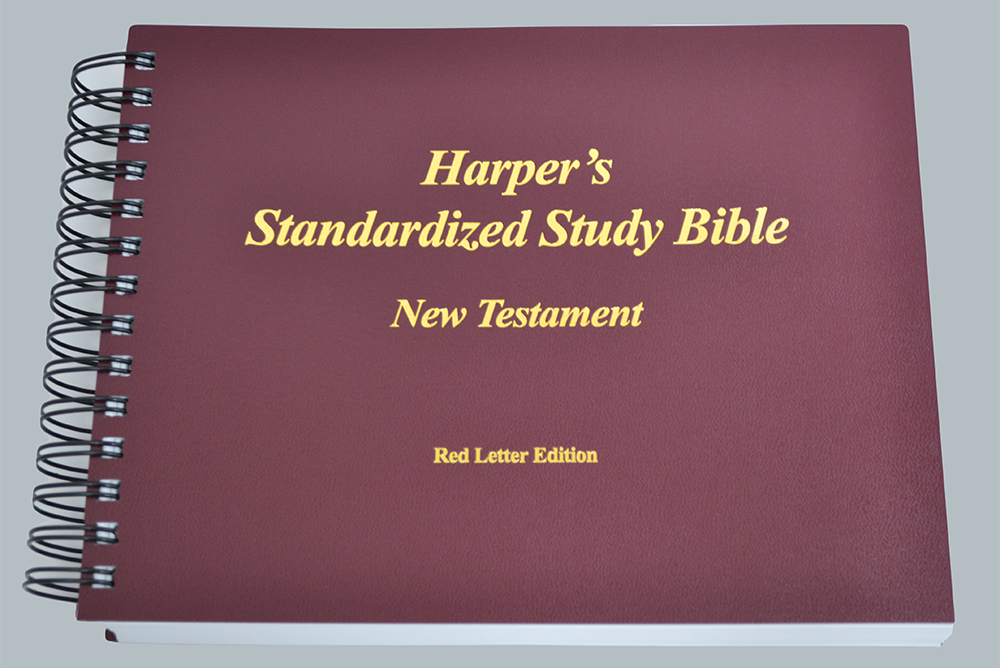
Harper’s Standardized Study Bible, New Testament, Red Letter Edition
An original translation of the Greek New Testament into English with Jesus Christ’s words printed in red. The red text enables readers to easily locate the Lord’s spoken words at a glance. A true study Bible that is spiral bound and lays flat for ease of note taking. Each page dedicates one column for personal notes.
Learn More